Table of Contents
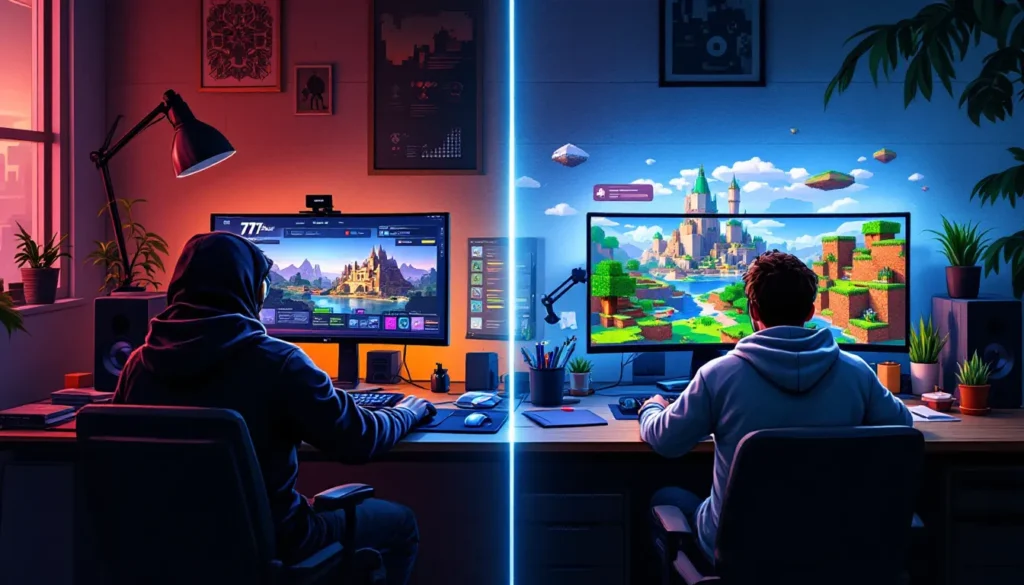
ToggleThe gaming landscape in 2026 continues to split into two distinct camps, and your preference between Call of Duty and Minecraft says more about your gaming DNA than you might think. These franchises represent opposing philosophies: one thrives on split-second reflexes and high-stakes competition, the other on patient creativity and emergent gameplay. Your choice between them isn’t really about graphics or genres, it’s about what you want from gaming itself. Whether you’re chasing frame-rate glory, building elaborate structures, grinding competitive ranks, or just unwinding after a long day, understanding what each franchise demands and offers is crucial. This guide breaks down the core differences, player profiles, and what might be the better fit for your gaming style heading into 2026.
Key Takeaways
- Call of Duty prioritizes fast-paced competitive gameplay with rank-based progression and mechanical skill, while Minecraft emphasizes creative freedom and relaxation without scoreboard pressure.
- A Call of Duty or Minecraft player’s choice reflects their gaming identity: competitive players seeking ranked progression versus creative players preferring self-directed goals and exploration.
- Minecraft offers superior cross-platform accessibility and works seamlessly across devices (Switch, mobile, PC), whereas Call of Duty demands higher hardware performance for competitive advantage.
- Both franchises operate as evolving services with seasonal content through battle passes and updates, competing for gaming time rather than sales since Microsoft owns both.
- Minecraft players can collaborate meaningfully across skill levels through creative projects, while Call of Duty communities are structured around competitive hierarchies based on K/D ratio and rank.
- Modern gamers don’t need to choose one franchise exclusively—many play Call of Duty for competitive sessions and Minecraft for relaxation, creating a hybrid gaming approach that suits different moods and schedules.
Understanding The Core Differences Between These Gaming Titans
Gameplay Style And Mechanics
Call of Duty is built on immediate feedback loops: you spawn, you hunt, you shoot, you die, repeat. Matches last 8-15 minutes. Every decision impacts a scoreboard visible in real-time. Minecraft operates on an entirely different timeline, sessions can stretch for hours or months, with no winning condition and no enemy keeping score against you. In CoD, your success is measured in K/D ratio, objective captures, and killstreaks. In Minecraft, success is what you define: clearing a cave system, completing a mega-build, finding diamonds, or simply relaxing next to a campfire you built.
The mechanical demands differ drastically too. Call of Duty requires precise aiming, map awareness, positioning, positioning, and the ability to process multiple threats simultaneously. Aim Assist exists but isn’t a crutch, even on controller, TTK (time-to-kill) windows demand consistency. Minecraft’s skill ceiling isn’t about mechanical reflexes: it’s about planning, spatial reasoning, and resource management. Building a functioning redstone computer isn’t about clicking fast, it’s about understanding logic gates and patience.
Target Audience And Player Demographics
Call of Duty has historically skewed toward players aged 16-35, with a competitive core but also a casual audience that jumps in for a few matches after work. The franchise attracts esports viewers, content creators building highlight reels, and players chasing ranked progression. Minecraft’s base is genuinely vast: kids learning spatial reasoning, adults building architectural projects, educators using it as a teaching tool, and streamers pulling massive concurrent audiences.
Demographically, Call of Duty players tend to have completed tutorials and understand FPS conventions, ADS sensitivity, loadout optimization, and meta weapons. Minecraft’s audience includes people who’ve never touched another game before. A 7-year-old can boot up Minecraft and create something worthwhile within an hour. A 7-year-old in Call of Duty? They’re getting spawn-trapped and learning some colorful vocabulary from teammates.
Graphics, Performance, And Platform Availability
Call of Duty demands horsepower. Modern Warfare III and Black Ops 6 (as of 2026) push 120+ FPS on high-end hardware, with visual fidelity tied to frame rate for competitive advantage. On console, you’re choosing between resolution and performance modes, most competitive players choose 120 FPS at 1440p over 4K at 60 FPS. PC players with decent rigs target 144-240 FPS. Mobile versions exist but aren’t the primary experience.
Minecraft is deliberately lo-fi visually, but scalability is its strength. It runs on a Nintendo Switch, an iPhone from 2018, and a $3,000 gaming PC with ray-tracing enabled. The base game hasn’t changed graphically in essence since 2011, voxel-based cubes, but performance options and shader packs let you tailor the experience. This accessibility is intentional: anyone can play, anywhere.
Platform availability: Call of Duty is on PC, PlayStation, Xbox, and mobile (with limitations). Minecraft is everywhere: PC, console, mobile, VR, education editions. If crossplay matters to you, both support it, but Minecraft’s implementation is more seamless.
The Call Of Duty Player Profile
Competitive Multiplayer Focus
A Call of Duty player is, first and foremost, chasing rank. Whether it’s multiplayer progression, Warzone ranked (CoD’s battle royale), or seasonal challenges, there’s always a ladder to climb. The multiplayer modes, Team Deathmatch, Domination, Search and Destroy, Hardpoint, each demand different skill sets, but they all share one thing: your performance is quantified. The game explicitly tells you how many kills you got, how many deaths, your objectives captured.
Loadout optimization is part of the identity. A CoD player knows their weapon spreads, understands meta shifts with patches, and builds classes around playstyle: aggressive rushers build different loadouts than sniper campers. Call of Duty Stats tools obsess over this, tracking K/D, win rates, and performance trends across modes and weapons.
Social hierarchy within CoD communities is often based on rank, K/D ratio, or content creation clout. High-level players are recognized. Streamers running 2+ K/D ratios are aspirational. The franchise thrives on competitive hierarchies.
Single-Player Campaign Experience
Call of Duty campaigns are blockbuster experiences. Black Ops 6, Modern Warfare III, and other recent entries deliver 5-8 hour narrative arcs with Hollywood-tier set pieces, recognizable voice actors, and plot twists. These aren’t afterthoughts, they’re full productions with budgets rivaling AAA films. You’re experiencing a curated story, not creating one.
The campaign teaches you the fundamentals: how gunplay feels, how to navigate complex environments, where threats come from. It’s also where Call of Duty Age: players feel the franchise’s cultural weight. These stories stick. The shock moments, the character arcs, the twists, they’re part of gaming discourse for years.
But campaigns aren’t the main draw. Most Call of Duty players boot campaign once, maybe replay it on higher difficulty, then spend 200+ hours in multiplayer. The campaign is the tutorial: multiplayer is the game.
Skills And Playstyle Characteristics
Call of Duty players develop specific skill sets: flick aiming (rapid target acquisition), pre-aiming (anticipating enemy positions), recoil control (managing spray patterns), and split-screen awareness (watching minimap while fighting). Sound design is critical, footsteps, gunfire direction, ability audio cues. Headphones aren’t optional: they’re essential.
Playstyle varies wildly. Rushers use SMGs and shotguns, relying on map knowledge and aggression. Mid-range players favor assault rifles and execute coordinated team plays. Snipers require patience and positioning. Support players focus on killstreaks that benefit the team. But all playstyles share the same core: react faster, position better, win engagements.
Rank anxiety is real for serious CoD players. Deranking due to a bad weekend, getting stomped by smurfs, dealing with disconnects, these are genuine emotional experiences. The game’s competitive backbone creates stakes. Even casual matches feel high-pressure because the matchmaking tries to balance skill.
The Minecraft Player Profile
Creative Freedom And Sandbox Exploration
Minecraft players don’t answer to scoreboards. A Minecraft player’s satisfaction comes from within, completing a build, establishing a base, discovering a naturally generated structure, or simply experimenting with game mechanics. The absence of objectives is the entire point. You set the win condition.
Exploration is core. Walking across a new world, discovering mountains, caves, villages, and bastions creates genuine awe moments. There’s no “meta” location, everywhere is potentially interesting. This is fundamentally different from Call of Duty’s Call of Duty Maps: where every inch is tested for balance and every sightline calculated for competitive fairness.
Creativity has no ceiling. A player might spend weeks building a Victorian mansion, complete with interior decoration and functioning doors. Another might create an entire village with NPC systems. Others build redstone computers that actually compute binary. The game enables these obsessions through its sandbox nature, if you can imagine it within the game’s rules, you can build it.
Survival mode adds resource scarcity and difficulty, but even Survival doesn’t impose deadlines. Mining for ore takes as long as it takes. Beating the Ender Dragon is optional. Most players never fight the final boss: they just keep building.
Community Building And Collaboration
Minecraft is deeply communal, but differently than Call of Duty. Rather than competing, Minecraft players collaborate. Multiplayer servers host dozens, hundreds, or thousands of players building together, each contributing to the shared world. Hermitcraft, the famous SMG (single-player multiplayer) community, showcases this: multiple content creators building independently but sharing the same world, inspiring each other with builds and projects.
Streaming Minecraft has exploded since 2020. Creators like PrestonPlayz and other builders pull serious viewership not from mechanical skill but from creative execution and personality. The appeal is different from watching a competitive CoD streamer, you’re watching someone build something beautiful or solve a puzzle creatively, not react to high-pressure engagements.
The community tools matter: mods, datapacks, texture packs, and servers. Unlike CoD’s centralized experience, Minecraft’s modding ecosystem lets communities redefine the game entirely. Pixelmon turns Minecraft into Pokémon. Crazy Craft adds absurd bosses and magic. The game becomes what its community wants. This drives retention for years, there’s always a new server variation to try, a new collaborative project to join.
Learning And Problem-Solving Approach
Minecraft rewards patience and systematic thinking. Mining efficiently isn’t about speed: it’s about tunnel systems and resource management. Building tall structures without collapsing requires understanding of physics (or at least empirical testing). Redstone logic requires thinking in circuits, AND gates, OR gates, timing mechanisms.
Kids use Minecraft to learn math (calculating build dimensions), resource management, and planning. Educators have built curricula around it. Teachers have used Minecraft Education Edition to teach history, geography, and science. The game naturally encourages problem-solving: “How do I get water up here?” leads to experimenting with water physics. “How do I stop mobs from spawning?” leads to understanding light levels.
This problem-solving extends to community collaboration. On large servers, players innovate together: “How do we automate this farm?” becomes a collective puzzle. The satisfaction comes from working through a challenge methodically, not from quick reflexes or frame-rate advantage. A 45-year-old parent and a 12-year-old kid can collaborate meaningfully in Minecraft: that’s much harder in Call of Duty.
Which Game Suits Your Gaming Preferences?
If You Crave Fast-Paced Action And Competition
Call of Duty is your game. If you want to measure progress in rank points, compare your K/D ratio to other players, and feel the rush of a high-kill game or a clutch 1v4 in Search and Destroy, Warzone’s ranked battle royale or multiplayer’s ranked modes are where you belong. Recent seasons have emphasized skill-based matchmaking, so ranked play positions you against similarly skilled opponents, losses feel like they mean something because the competition is real.
The meta shifts constantly. Patches update weapon balance every 1-2 weeks. A dominant gun might get nerfed (damage reduced, recoil increased), making you adapt your loadout. This keeps the competitive scene fresh. Players who thrive on optimization love this, studying patch notes, testing new builds, and exploiting buffs before others catch on is part of the fun. Sites like Dexerto cover meta shifts obsessively because the audience craves this information.
If you’ve played FPS games before (Valorant, Halo, Counter-Strike), Call of Duty will feel immediately comfortable. The conventions are familiar. You’ll climb the ranked ladder. You’ll have moments of genuine skill expression, a perfect pre-aim killing an unsuspecting enemy, a coordinated team push executing flawlessly, pulling off a 1v3 clutch. These moments are tight.
If You Prefer Relaxation And Creative Expression
Minecraft is your sanctuary. Not everything in gaming needs to generate anxiety. If you log in to unwind, put on a podcast, and spend two hours terraforming a mountain or decorating your house, Minecraft delivers that consistently. There’s no one waiting for you to perform, no rank decay if you take a week off, no teammates flaming you for a bad play.
Creative Mode removes resource limitations entirely, you have infinite blocks and tools. Build whatever, whenever, but. Survival Mode adds challenge but keeps pressure manageable. If you die, you respawn. Lose your items? You’ll gather more. No permanent consequences, only learning experiences.
The barrier to entry is tiny. You don’t need prior gaming knowledge. You don’t need a high-refresh-rate monitor or perfect aim sensitivity. You need imagination and patience. That’s it. A parent who hasn’t gamed in 15 years can boot Minecraft, follow a simple building tutorial, and feel accomplishment within an hour. Try that with Call of Duty, you’ll be confused and frustrated until at least hour five.
Minecraft also scales across devices seamlessly. Play on PC at your desk, switch to mobile on your commute, jump onto console at a friend’s house. Progress syncs via Microsoft account. The game adapts to your schedule and location.
If You Want Both Worlds: Hybrid Gaming Approaches
Here’s the reality: most gamers don’t pick one and abandon the other. Many play both, just at different times. Call of Duty for competitive sessions when focus is high, Minecraft for chill evenings when you want background music and conversation.
There’s also nuance within each franchise. Call of Duty’s campaign and co-op Zombies mode offer lower-pressure experiences than ranked multiplayer. Minecraft’s Hardcore mode (permadeath) can be genuinely stressful for some players. Neither game is monolithic.
If you want both tension and creativity, consider hybrid games: Fortnite offers building mechanics (like Minecraft) with competitive multiplayer. Rust or Valheim blend survival (Minecraft-style) with PvP stakes (CoD-style). Games like Satisfactory or Grounded offer construction depth with exploration. The Loadout covers guides on games that straddle these mechanics.
For many modern gamers, the question isn’t “Call of Duty or Minecraft?” It’s “Can I play CoD when I want to sweat, and Minecraft when I want to chill?” The answer is absolutely yes. These games aren’t mutually exclusive: they serve different moods. A dedicated gamer might grind CoD ranked in the morning, then boot a Minecraft Survival world after dinner.
The Future Of Both Franchises And Gaming Communities
Upcoming Titles And Innovation In 2026 And Beyond
Call of Duty’s roadmap for 2026 continues the annual/biennial release cycle. Infinity Ward’s next mainline title is expected to iterate on the modern engine foundation while pushing campaign narratives and multiplayer innovation. Expect expanded Warzone integration, possibly new map rotations, and balance adjustments based on competitive feedback. The esports ecosystem around Call of Duty, franchise leagues, professional tournaments, shows no signs of slowing. Investment in this remains substantial.
Minecraft’s development is less flashy but equally continuous. Snapshots (experimental builds) release regularly, introducing features like new biomes, mobs, and mechanics before full releases. The 2026 roadmap includes continued work on Caves and Cliffs infrastructure, potential new dimensions, and deeper mod support. Minecraft education initiatives are expanding globally, which indirectly validates the game’s legitimacy as more than just “for kids.”
Cross-franchise innovations are interesting too. Both games are experimenting with procedural generation, AI improvements, and data-driven balance updates. Call of Duty uses machine learning to detect cheaters. Minecraft uses algorithms to generate more varied terrain. The technological arms race continues but follows each franchise’s philosophy: CoD optimizes for competitive balance, Minecraft for creative potential.
Seasonal content keeps both alive. Call of Duty releases battle pass content every few weeks, new weapons, skins, challenges. Minecraft does the same through snapshots and official “episodes” (like The Wild Update, The Caves & Cliffs expansion). Both understand that games are services now, not products. You’re not buying a complete game in 2026: you’re buying access to an evolving world.
Cross-Platform Evolution And Accessibility
Cross-platform play is no longer novel, it’s expected. Both Call of Duty and Minecraft support it. But, Call of Duty faces a mechanical disadvantage: controller players compete with mouse-aim players. Aim Assist exists to bridge this gap, but the debate over Aim Assist balance is perpetual in competitive communities. Keyboard-mouse remains the gold standard for competitive FPS gaming, which limits console dominance in ranked play.
Minecraft has no such problem. Building, mining, and exploring work equally well on controller or keyboard-mouse. This gives Minecraft true cross-platform harmony. A Switch player and a PC player collaborate seamlessly.
Accessibility is expanding in both. Call of Duty has added colorblind modes, audio descriptions, and customizable controls. Minecraft’s accessibility features include subtitle systems, adjustable text size, and remappable controls. Games targeting broader audiences understand that accessibility isn’t optional, it’s standard. Twinfinite regularly covers accessibility features in major titles.
The future likely includes more mobile optimization. Call of Duty: Mobile exists but is separate from console/PC. Minecraft is fully mobile-first: the game thrives on Nintendo Switch and iOS. As mobile hardware improves, we might see tighter parity between Minecraft mobile and PC. Call of Duty’s mobile future is less certain, the franchise has historically prioritized core platforms.
One final trend: subscription services. Both games are available through Microsoft Game Pass (since Microsoft owns both franchises). This bundling will drive casual adoption. Players trying Call of Duty for the first time through Game Pass might discover they prefer Minecraft. Or vice versa. The rivalry between these franchises is less about sales (Microsoft captures both) and more about capturing gaming time. In 2026, that’s the real competition: which game keeps you engaged longer?
Conclusion
Choosing between Call of Duty and Minecraft isn’t choosing between better and worse, it’s choosing your gaming identity. Call of Duty players are competitive, rank-driven, and thrive on reflexive excellence. Minecraft players are creative, exploratory, and find meaning in self-directed goals. Neither is objectively superior: they’re fundamentally different experiences.
The real takeaway: understand what you actually want from gaming. Do you want to climb a ranked ladder and prove mechanical skill against opponents? Do you want to build something lasting and beautiful? Do you want both, depending on your mood? There’s no wrong answer. Gaming in 2026 is diverse enough to support every approach. Call of Duty’s competitive spine shows no signs of weakness. Minecraft’s creative ecosystem is stronger than ever. The franchises will likely continue parallel evolution, one pushing esports and competition, the other pushing creativity and accessibility.
Pick the game that matches your goals. Better yet, don’t pick just one. The beauty of modern gaming is you don’t have to.